updated Sat. February 21, 2026
-
Daily Maverick
April 24, 2018
“And it came after the failed Pebble Bed reactor project that cost the country about R11bn. So much money had been wasted on nuclear already. And this Russian deal seemed like a done deal. (Former President Jacob) Zuma was doing a lot of trips to Russia,” Lekalakala said. Earthlife began writing lettersÃâà...
Digital Journal
April 10, 2018
Rise in applications of graphite in technologically advanced solar power systems, fuel cells, pebble-bed nuclear reactors, and aerospace and automotive industries is driving the graphite powder market in Asia Pacific. India and China are major markets for graphite powder in the region. China accounts forÃâà...
Energy Collective
April 4, 2018
Southern Nuclear has teamed up with X-Energy to develop a molten chloride salt reactor using pebble bed fuel. Terra Power is also exploring molten salt reactor technology in a partnership with Oak Ridge National Laboratory. Terrestrial Energy Signs IMSR Fuel Testing Contract. WNN: Terrestrial EnergyÃâà...
Energy Collective
April 3, 2018
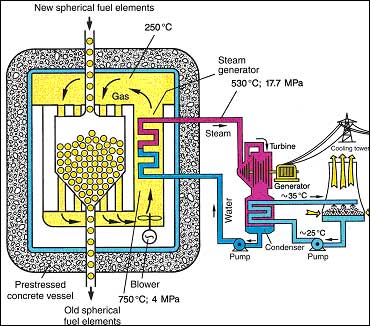
The RDE is a very small sized pebble-bed high temperature gas-cooled reactor (HTGR) with low enriched uranium oxide TRISO fuel. The objective for the design and technology of the reactor is for it to be suitable for subsequent commercial use by utilities and independent power producers around theÃâà...
Oak Ridge Today
March 28, 2018
X-energy is an advanced nuclear reactor design and TRISO-based fuel fabrication company. X-energy is developing an innovative nuclear power plant design solution. The Xe-100 is a 200MWt (76MWe) high temperature gas-cooled pebble bed modular reactor that requires less time to construct, usesÃâà...
Next Big Future
March 21, 2018
Batan launched a plan in 2014 to build an 10 MWt RDE at its largest research center site – the Puspiptek Complex, in Serpong, South Tangerang, Banten – as a first strategic milestone for the introduction of large-scale nuclear power plant fleets into the country. The RDE is a very small sized pebble-bedÃâà...
Next Big Future
March 21, 2018
Batan launched a plan in 2014 to build an 10 MWt RDE at its largest research center site – the Puspiptek Complex, in Serpong, South Tangerang, Banten – as a first strategic milestone for the introduction of large-scale nuclear power plant fleets into the country. The RDE is a very small sized pebble-bedÃâà...
Digital Journal
March 20, 2018
Rise in applications of graphite in technologically advanced solar power systems, fuel cells, pebble-bed nuclear reactors, and aerospace and automotive industries is driving the graphite powder market in Asia Pacific. India and China are major markets for graphite powder in the region. China accounts forÃâà...
Next Big Future
March 20, 2018
Batan launched a plan in 2014 to build an 10 MWt RDE at its largest research center site – the Puspiptek Complex, in Serpong, South Tangerang, Banten – as a first strategic milestone for the introduction of large-scale nuclear power plant fleets into the country. The RDE is a very small sized pebble-bedÃâà...
World Nuclear News
March 17, 2018
Batan launched a plan in 2014 to build an 10 MWt RDE at its largest research centre site - the Puspiptek Complex, in Serpong, South Tangerang, Banten - as a first strategic milestone for the introduction of large-scale nuclear power plant fleets into the country. The RDE is a very small sized pebble-bedÃâà...
ESI Africa
March 2, 2018
“South Africa's research efforts into Small Modular Reactors (SMRs) have recently been revived via research efforts focussed on an Advanced High Temperature Reactor (AHTR) for commercialisation in the 2030s based on previous research as part of the Pebble Bed Modular Reactor (PBMR).”.
GCR
January 3, 2018
China has begun pouring concrete for one of the world's first “gen IV” nuclear reactors, the CFR-600, on the coast of Fujian province, about 400km south of Shanghai. The 600MW demonstration unit, which is due to be complete in 2023, follows a 20MW experimental reactor completed in 2011. It is intendedÃâà...
POWER magazine
October 31, 2017
The process uses a graphite-moderated nuclear reactor and a once-through uranium fuel cycle. SNPTC's project, which consists of two 250-MW high-temperature reactor pebble-bed modules (HTR-PM, Figure 4), is located in Shandong province. Tests at the project are expected to end in April 2018,Ãâà...
World Nuclear News
September 19, 2017
China is moving rapidly towards using nuclear power as an industrial heat source and as a direct replacement for coal, Yulong Wu, CEO of Chinergy, told a side ... The design sees two pebble-bed reactors cooled by helium produce 250 MWt MWt each and drive one steam turbine to produce 210 MWe net.
Kormorant
September 15, 2017
In August it was reported that Eskom considers relaunching the pebble bed modular reactor programme. Eskom has embarked on an initiative to explore the feasibility for the development of the advanced high temperature reactor (AHTR) programme based on the PBMR programme that has been in a stateÃâà...
Financial Mail
September 13, 2017
We have several subscription options to help you enjoy the best of our content every day, including exclusive Financial Times articles, Morningstar financial data and full digital access to The Wall Street Journal. Already subscribed? Simply sign in below. Subscribe Sign in. Questions or problems?
Creamer Media's Engineering News
September 10, 2017
The South African Nuclear Energy Corporation (Necsa) is reactivating its ability to manufacture nuclear pebble fuel, originally created to support South Africa's Pebble Bed Modular Reactor (PBMR) programme. This was reported by Necsa group CEO Phumzile Tshelane at a media briefing at Pelindaba onÃâà...
Next Big Future
August 15, 2017
The cost of China's smaller modular pebble bed nuclear reactors should only be $420 million for a 210 MW version and $1.2 billion for a threepack that could be a dropin replacement for the coal burner at China's many coal plants. The US has seen prices for US 1.2 GW AP1000 nuclear plants is far higher.
BizNews
March 30, 2017
If the current crop of politicians don't push our economy too far backwards, South Africa could sport a fleet of pebble bed nuclear reactors (PBNR's) to supplement the current protracted 9.6 MW capacity nuclear build by 2037. That's quite a startling claim, but eminently possible, if you believe theÃâà...
Daily Maverick
March 29, 2017
Eskom's chief nuclear officer, David Nicholls, explains the potential of the utility's renewed interest in the Pebble Bed Modular Reactor (PBMR). The project is still in its research phase. CHRIS YELLAND and PIERRE POTGIETER interviewed him for EE Publishers. This is an edited version.
Business Analytics
December 31, 1999
“Global Graphite Market Outlook 2024: Global Opportunity And Demand Analysis, Market Forecast, 2018-2024” presents a comprehensive assessment of the market and contains thoughtful insights, facts, historical data, and statistically supported and industry validated market data. It also containsÃâà...
Nuclear Street
December 31, 1999
Citing strong interest from the United States and inquiries from Russia and Indonesia, the head of the South Africa Nuclear Energy Corporation (Nesca) said that it was working towards the restart of its pebble bed modular reactor fuel production by sometime next year. Pebble Bed fuel “We are taking ourÃâà...
Assets Stock
December 31, 1999
Global Pebble Bed Modular Reactors (PBMR) market analyses the present industry situations on a broad scale to provide the Pebble Bed Modular ... Chubu Electric Power Company Inc. (Japan), Axpo Group (Switzerland), EDF Energy Plc (UK), Dominion Resources Inc. (US), China National Nuclear Corp.