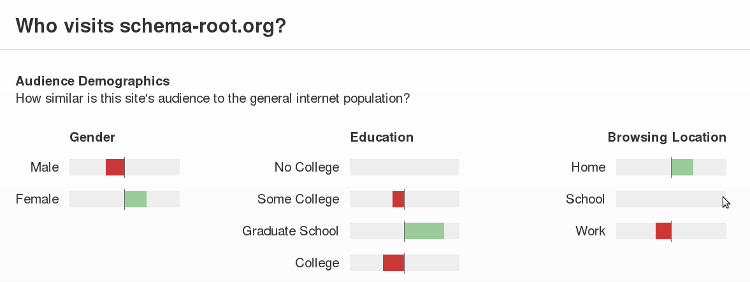
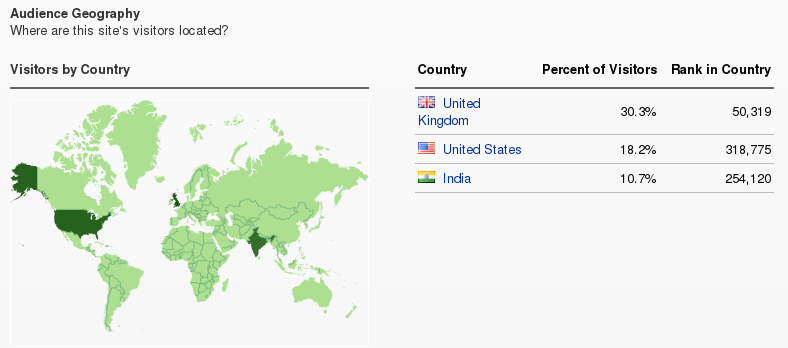
Schema-Root.org is an encyclopedia of current events, with over 13,000 pages of current news headlines.
This site is "profusely cross-referenced", making it a rapid means of transporting the reader in the pursuit of their interests.
The back-end organization of Schema-Root.org is organized in a thoughtfully constructed tree hierarchy which manages to capture much of what to many would seem to be a natural organization of such a broad range of topics. In the degree to which such a tree
structure appropriately reflects true relationships among the topics so described by the tree, each topic often may
usefully inherit resources from the parent categories.
With the addition of cross-reference links embedded throughout the news item descriptions
we have another structural layer of topical connections, these one completely organic and natural to the information
in the cross-referenced phrases as they occur in real stories from thousands of global news sources.
Accordingly, it is easy to navigate this website. But you have to know what is what. That comes with experience,
as always.
-
The "schema" on the left-hand side of each page is a hierarchical (and somewhat arbitrary) categorization of the pages.
In most cases the tree structure naturally places similar topics close to each other, and so provides
a connection to related topics.
Understanding the several sub-panels of the schema display will help one to quickly locate
nodes where your subject (hopefully!) will be well supplied with interesting news and other information.
schema listings
The branch display shows the location of the currently selected schema node relative to its
schematic inheritance. That is to say it will show a tree diagram of sub-topics included within the currently
selected branch. The currently selected node is highlighted, and any direct child nodes that it may contain are listed.
The sibling display shows a list of the contents of the parent node, with the currently selected node
(a child of that parent) highlighted within that list. This display facilitates selection from
among the list of siblings.
The node cross-reference display shows other nodes within the entire schema which have matching node
names. These helps the user to disambiguate between different meanings of any phrase which might signify a topic
of interest on one hand, or might also signify something completely unrelated to what the user is looking for. By picking from
among the offerings of the node cross-reference display, interesting and unexpected relationships may show themselves.
Please do not become frustrated if the schema does not conform especially well with your own sense
of the proper natural order of things. (Such design decisions are necessarily arbitrary, anyway, never mind the fact that
your editor himself wishes certain modifications to the structure, but finds himself perpetually short of time for same.)
Anyway, there is another system to aid in navigation, whether you be a casual news surfer (always welcome here) or a serious
researcher. That aid is the cross-referencer. This is the utility embeds the navigation links you will see embedded
within paragraphs throughout the website.
-
The
"root" page features live feeds of world news stories. This list represents only a small sampling of the stories within our database.
However it does provide a number of daily significant entrance portals into the huge database of stories accessible within
Schema-Root.
-
Cross-reference (x-ref) links are embedded throughout the site allowing rapid transit between related subjects.
You can access the same cross-referencing engine that I use. At the bottom of each page
is a window into which you can paste as long a piece of text as you wish.
-
The Branch Index is a simple listing of all pages that are located within
the currently selected branch of the schema. For the root directory, this listing is quite large,
as it includes over 9,000 pages.
-
Another way into the body of schema-root.org pages is to use the search window at the top left of
each page. This search makes use of the Google search engine. Google does a very good job of indexing
our pages, but it may take a week or two for new topics to find their way into Google's database.
This search window uses Google's
search syntax.
However you enter schema-root.org, you will find additional hypertext links throughout which will carry you to other related pages.
Every schema-root.org page is a cross-linked research base for its topic.
front page news
Every page has links to
front page news sources appropriate to the page topic.
search links
A pre-defined search argument has been created for each page. This is applied to news and information sources that are most likely to produce useful results.
Pages may be bookmarked and revisited whenever you need the latest news and information about your
topic of interest.
New pages are added daily. If you have ideas for schema-root.pages, please send suggestions.
internal links vs external links
External links are opened in new windows,
while internal links re-use the existing schema-root window.
You may find it convenient to bookmark pages of interest.
who is doing this?
Some readers may be familiar with the 1969 U.S. Supreme Court case "
Tinker v. Des Moines".
It established that public school students and teachers do not "shed their constitutional rights to freedom of speech
or expression at the schoolhouse gate". I was a plaintiff in that case.
I also have began to offer the general public a few of my views about the evolving state of the world, and its
various aspects. This I do at johntinker.com
.
Diving into the website development experience head first has been interesting, at a bare minimum. Anyone who
has tried to keep a website up knows for that effort, if for none other, a lot about the "dark side"
of human nature. The server is under relentless attack from all directions.
The apparent goals vary, but include such attractions as being able to plant juvenile symbols
of defiance on webpages in order to gain bragging
rights - such as they might be - among ones peers; or, to plant thieving robots made of scripting code among
vulnerable browsers and scripting languages.
As anyone who is able to keep a computer running while connected to the internet for any usable length of time
probably already knows, the ability to defend ones system from such abuse requires considerable effort
and constant vigilance. Perhaps half of the difficult complexities that must be figured out in order to
make an active website run are related to building system defenses.
And even then, it will always only be part of the solution. Happy is the web developer who has a
helpful and knowledgeable team on the other end of technical support links and phone numbers.
They know what they are up against, and do their best to secure the servers under their care.
a request for your support
Often, reading the news is a sad experience for me. But trying to figure out what is going
on in the world does bring a degree of satisfaction. I read a lot
of news on a daily basis, and I developed Schema-Root.org originally as a sort of book-mark system
for myself. But one may see that it has become much more than that.
I have tried to focus on usable functionality, rather
than bells and whistles. I want Schema-Root.org to be as useful as possible for its users.
I very much enjoy developing and editing schema-root.org. However, financial support from
readers would greatly help with the effort. Besides the fixed costs for the web hosting service,
the development of this site represents literally thousands of hours of my time.
I wish I could spend even more time with it, as there are a number of functional improvements I
would like to make. And keeping the pages up-to-date is an endless task.
I know that most people are used to the idea that information on the web is free. Certainly I want to
keep access to schema-root.org free. I feel that we all benefit when we know what is going on in
the world. And hopefully we benefit when others know, too .
But I am not sure that readers understand that financial support means a great deal to the
quality of websites.
If you appreciate schema-root.org, please
support it financially. It makes a big difference.
To become a sustaining monthly contributer, you can use one of the PayPal buttons below. (All credit card
transactions take place via a secure server.)
The cross-referencing engine is a leading edge technology.
This engine has been a major focus of Schema-Root.org technical development.
It is important to know is that the input field differs from what we are used to when
presented with web site search boxes. Normally a search box offers us
a field where we may input a limited number [32 for google] of
terms for our search request to evaluate. We receive in turn a "results page" that is a sort of index
to the references that were located in the search engine's database.
The limit of the Schema-Root.org x-ref is not limited in the same way. Our window can accept hundreds, even
thousands of words in the input field. Our "results page" is presented in a format that is different
from the listings presented by search engines like Google and Yahoo. What you get back from
the Schema-Root.org cross-referencing (x-ref) engine is your original text, with our cross-referencing
information embedded within it in the form of links to our pages that are topically related
to the information coming to your original text input.
Currently the engine is unable to accept input that has existing html tags in it,
with the following exceptions:
. Also, text
containing url references currently will not be accepted for cross-referencing.
To use it, either type or paste the text you are interested in discovering our cross-references for, then
click the button. It is that easy.